
Marketing

Vancouver Appliance Load Capacity Mistakes: How Overloading Your Washer, Dryer, and Dishwasher Destroys Motors and Costs Thousands in Premature Replacements

Vancouver Appliance Load Capacity Mistakes: How Overloading Your Washer, Dryer, and Dishwasher Destroys Motors and Costs Thousands in Premature Replacements Tired of dealing with constant appliance breakdowns that could have been easily prevented? Let’s dive into the hidden dangers of overloading your household appliances and how this simple mistake is costing Vancouver homeowners thousands in unnecessary repairs and premature replacements. Picture this: you’re rushing to get that last load of laundry done before your week gets crazy, so you stuff just a few more towels into an already-full washing machine. Or maybe you’re hosting dinner and decide to cram every single dish into the dishwasher to save time. These seemingly innocent decisions are actually setting you up for some seriously expensive consequences that most Vancouver homeowners never see coming until it’s way too late. Related Services: Dishwasher Repair | Washing Machine Repair | Dryer Repair What many people don’t realize is that modern appliances are precision-engineered machines with very specific load capacity limits that aren’t just suggestions – they’re critical operating parameters. When we push past these limits, we’re essentially asking our washers, dryers, and dishwashers to perform superhuman feats that their motors, bearings, and mechanical systems simply weren’t designed to handle. The result? A cascade of component failures that can turn a $800 appliance into a $300 repair bill, then another $400 repair six months later, until you’re looking at replacement costs that could have been completely avoided. The coastal environment here in Vancouver adds another layer of complexity to this problem. Our persistent humidity and salt air create the perfect storm for accelerated component wear, especially when appliances are already stressed from chronic overloading. It’s like asking someone to run a marathon while carrying a heavy backpack in challenging weather conditions – something’s going to give way faster than it should. Key Outtakes Overloading washing machines causes bearing damage, motor burnout, and suspension system failures that can reduce appliance lifespan from 10-14 years down to just 3-5 years of actual service Dishwasher overloading leads to spray arm motor damage, pump failures, and drainage problems with repair costs averaging $175-$325 per incident, often requiring multiple service calls Dryer overloading creates fire hazards through motor overheating and thermal fuse failures while blocking essential airflow needed for safe operation Vancouver’s coastal humidity and salt air compound overloading damage, creating faster corrosion and moisture infiltration that accelerates component degradation beyond normal wear patterns The cumulative cost of repairs from chronic overloading frequently exceeds the purchase price of a replacement appliance within 5-7 years, making load management a critical financial strategy for homeowners Understanding Appliance Load Capacity and the Hidden Damage Process Every appliance in your home comes with carefully calculated load capacity specifications that represent thousands of hours of engineering testing and safety analysis. These aren’t arbitrary numbers printed in manuals that no one reads – they’re the result of extensive stress testing to determine exactly how much weight and volume each component can handle while maintaining reliable operation over the appliance’s expected lifespan. When we talk about a washing machine having a capacity of 4.5 cubic feet or a dryer handling 7.5 cubic feet, these measurements directly correlate to motor torque requirements, bearing load limits, and structural stress thresholds. The damage process from overloading doesn’t happen overnight like a sudden catastrophic failure. Instead, it’s a gradual accumulation of stress that weakens components over months and years of abuse. Think of it like constantly lifting weights that are just slightly heavier than what your muscles can safely handle – you might get through the workout, but you’re creating micro-damage that eventually leads to injury. Your washing machine’s drum bearings experience this same gradual degradation when forced to support loads that exceed their engineering specifications. What makes this particularly insidious is that modern appliances are designed to operate even when overloaded, at least initially. Your washer will still run its cycle, your dryer will still heat up, and your dishwasher will still spray water. The machine doesn’t immediately break down and refuse to work, so homeowners get a false sense that everything is fine. Meanwhile, internal components are experiencing stress levels that guarantee premature failure, but the symptoms won’t become obvious until significant damage has already occurred. Vancouver’s unique coastal environment adds an extra layer of complexity to this damage process. The persistent humidity that characterizes our climate, especially during those long winter months of constant drizzle, creates conditions where moisture can infiltrate appliance housings and accelerate corrosion of metal components. When you combine this environmental stress with the mechanical stress of overloading, you get a perfect storm of accelerated wear that can cut appliance lifespans in half. The Mechanical Destruction: How Overloading Systematically Destroys Your Appliances Let’s start with what happens inside your washing machine when you consistently overload it, because the damage pattern here is both dramatic and expensive. The drum bearings in your washer are precision-engineered components that support the rotating drum during wash and spin cycles. Under normal operating conditions, these bearings are designed to handle the distributed weight of clothes, water, and the drum itself for approximately 10-14 years. But when you overload the machine, you’re asking those same bearings to support concentrated weight loads that can be 50-100% higher than their design specifications. The bearing damage doesn’t just affect the bearings themselves. As these components wear down from excessive stress, they allow the drum to shift and become misaligned during operation. This misalignment creates additional stress on the drive belt, which starts to wear unevenly and may eventually snap. The motor, trying to compensate for the increased resistance from misaligned components and heavy loads, begins drawing more current and generating excess heat. This heat degrades the motor windings, leading to eventual motor failure that can cost $320-$400 to repair. But here’s where it gets really expensive: appliance damage from overloading rarely happens in isolation. What starts as a simple bearing problem becomes a cascade of component failures. The suspension system, which includes springs and shock absorbers


Vancouver Appliance Load Capacity Mistakes: How Overloading Your Washer, Dryer, and Dishwasher Destroys Motors and Costs Thousands in Premature Replacements Read More »

Vancouver Appliance Black Friday Buying Guide: Why Those ‘Deal’ Appliances Break Faster and Cost More in Repairs Than Premium Models

Vancouver Appliance Black Friday Buying Guide: Why Those ‘Deal’ Appliances Break Faster and Cost More in Repairs Than Premium Models Thinking about scoring a killer Black Friday deal on appliances for your Vancouver home? Before you get swept up in those flashy “50% off” tags, let’s dive into why those discount appliances might end up costing you way more than you bargained for in repairs and replacements.Picture this: It’s Black Friday morning, you’re scrolling through Coast Appliances’ website, and you spot a Samsung refrigerator marked down from $1,200 to $700. Your brain immediately starts calculating the $500 you’re “saving,” and you’re already mentally spending that money on something else. But here’s the plot twist that retailers don’t want you to know—that discount isn’t just a generous markup reduction. It’s often a red flag that the appliance was engineered with cheaper components specifically to hit that lower price point.[IMAGE PLACEHOLDER FOR IMAGE1]As someone who’s spent years helping Vancouver homeowners navigate appliance purchases and repairs, I’ve seen the heartbreaking pattern over and over again. The same folks who were thrilled about their Black Friday “steals” are calling me two years later, frustrated that their supposedly great deal is already breaking down and costing them hundreds in repairs. The truth is, those deeply discounted appliances aren’t just cheaper to buy—they’re literally built to be cheaper, with cost-cutting measures that virtually guarantee they’ll fail faster than their premium counterparts.The appliance industry has gotten really good at creating the illusion of value while actually delivering products that will cost you more in the long run. When manufacturers need to hit those rock-bottom Black Friday price points, they don’t just reduce their profit margins—they systematically downgrade components, use thinner materials, and accept higher failure rates as the cost of competing in the discount market. Key Outtakes: Appliances discounted by more than 40% during Black Friday often use inferior components and materials to achieve lower price points, leading to failures within 4-6 years instead of the 8-12 years typical for standard models The 50/50 rule reveals the hidden trap: when repair costs exceed 50% of an appliance’s purchase price, replacement becomes more economical—a threshold reached much faster with deeply discounted Black Friday purchases Premium brands like Sub-Zero, Bosch, and Miele deliberately avoid Black Friday promotions, maintaining consistent pricing and focusing on 15-20+ year lifespans that provide better total cost of ownership Vancouver consumers face additional challenges with discount appliances due to limited local repair infrastructure for budget brands and longer parts delays for overseas manufacturers like Samsung and LG Package deals bundling 3-4 premium appliances during Black Friday can provide genuine value, with additional 10% rebates making quality brands accessible at prices approaching mid-tier alternatives The Black Friday Appliance Market Reality in Vancouver Let’s start by understanding what’s actually happening during Black Friday appliance sales. The traditional one-day shopping frenzy has morphed into a month-long promotional marathon that kicks off in early November and stretches through December. This extended timeline creates a false sense of urgency—like these deals are once-in-a-lifetime opportunities when similar promotions actually happen multiple times throughout the year.Major retailers including Best Buy, Home Depot, and Lowe’s control about 80% of appliance sales across North America, and they’ve gotten incredibly sophisticated at structuring their Black Friday inventory. They’re not just randomly marking down their regular stock. Instead, they’re specifically featuring models that have been engineered to hit certain price points, often with lower profit margins and, more importantly, higher expected failure rates.Here in Vancouver, we’re part of this broader North American retail ecosystem, but we also have unique players like Coast Appliances running their own Black Friday promotions. While these local retailers can offer competitive pricing and better service, they’re still dealing with the same manufacturer constraints that create the quality versus price dilemma we’re talking about.The economics behind those jaw-dropping discounts are pretty revealing. When you see a refrigerator marked down from $1,200 to $600, that’s not just a retailer being generous with their margins. Those kinds of discounts—50% or more—typically signal that the manufacturer has made specific design and component choices to enable that lower price point. They’re not temporarily losing money on each sale; they’ve created a product that can be profitably sold at that discounted price by using cheaper materials and accepting shorter lifespans.What’s particularly interesting is how luxury brands handle Black Friday. Companies like Sub-Zero, Wolf, and Miele largely stay out of the Black Friday game entirely. Instead of participating in the discount frenzy, they maintain consistent year-round pricing and focus on the value proposition of durability and performance. Sub-Zero offers $1,000 rebates on Cove dishwashers with qualifying purchases throughout the year, while Thermador actually announced 3-8% price increases starting January 1, 2025. This tells you something important: the brands that are most confident in their products’ longevity don’t feel the need to compete on Black Friday price cuts.[IMAGE PLACEHOLDER FOR IMAGE2]The Vancouver market faces additional complications due to Canadian import regulations and currency fluctuations. While we see similar promotional tactics as American markets, Canadian retailers have to navigate different tariff structures and warranty requirements. This can actually work in our favor sometimes—Canadian consumer protection laws provide stronger statutory rights than many U.S. states, typically covering goods for up to six years regardless of manufacturer warranties. Why Discount Appliances Are Engineered to Fail Faster Now we’re getting to the heart of the matter. When manufacturers design appliances for different price tiers, they’re not just adding or removing features—they’re making fundamental decisions about component quality that directly impact how long the appliance will last.The dirty secret of appliance manufacturing is that when a company produces both a $500 washing machine and a $1,500 washing machine, they often share 70-80% of their internal components. The difference isn’t just bells and whistles; it’s that the expensive model gets better versions of those shared parts. But here’s where it gets tricky: manufacturers recognize that using premium components in their high-end models creates unsustainable price gaps. So instead of upgrading the expensive models, they

Vancouver Appliance Black Friday Buying Guide: Why Those ‘Deal’ Appliances Break Faster and Cost More in Repairs Than Premium Models Read More »

Vancouver Appliance Strange Smells Diagnosis: What That Weird Odor Really Means and When It Signals Expensive Damage Coming

Vancouver Appliance Strange Smells Diagnosis: What That Weird Odor Really Means and When It Signals Expensive Damage Coming Catching a whiff of something funky coming from your Vancouver appliances and wondering if you should panic or just grab the cleaning supplies? Understanding the difference between normal appliance odors that need simple cleaning and dangerous warning signs that require immediate professional attention could literally save your life and thousands in repair costs. Related Services: Fridge Repair | Dishwasher Repair | Washing Machine Repair | Dryer Repair Picture this: you’re making dinner in your Burnaby kitchen when suddenly you catch a strange smell that makes you pause mid-chop. Is that the lingering aroma of last night’s salmon, or something more sinister lurking in your gas range? As Vancouver homeowners, we face unique challenges that most appliance troubleshooting guides completely ignore. Our coastal climate creates specific smell patterns that can signal problems long before visible damage appears, and knowing how to read these warning signs is absolutely crucial for keeping your family safe. What makes Vancouver particularly challenging is how our notorious rainfall, salt-laden ocean air, and dramatic humidity swings create the perfect storm for appliance problems that manifest as unusual odors. Between the salt air corroding gas connections faster than usual and our wet climate promoting mold growth in places you’d never expect, Vancouver homes face appliance hazards that require extra vigilance. The scary truth is that many homeowners dismiss dangerous warning signs as “normal” appliance funk, putting themselves at serious risk. I’m going to walk you through exactly what each type of appliance smell means, when you need to drop everything and call emergency services immediately, and those specific Vancouver considerations that most safety guides completely ignore. From the unmistakable rotten egg smell that signals a natural gas emergency to those sweet chemical odors that indicate refrigerant leaks, we’ll cover every scenario so you know exactly when to panic versus when to schedule a maintenance appointment. Key Takeaways Different appliance smells indicate specific problems – burning plastic signals electrical issues, rotten eggs means gas leaks, and chemical odors suggest refrigerant problems requiring immediate attention Vancouver’s coastal humidity and salt air accelerate appliance corrosion and mold growth, creating unique smell patterns that require more frequent maintenance than inland cities Ignoring appliance smell warnings can escalate repair costs from $75-200 for early intervention to $1,200+ for major component failures, plus potential safety hazards Carbon monoxide from malfunctioning appliances is odorless but deadly, making working CO detectors mandatory in all Vancouver buildings with fuel-burning appliances Professional appliance smell diagnosis costs $139-179 in Vancouver but prevents 85% of expensive breakdowns when combined with proper seasonal maintenance Understanding Vancouver’s Unique Appliance Smell Challenges Vancouver’s coastal environment creates environmental stressors that distinguish it from virtually every other major Canadian metropolitan area, and these conditions directly impact how and why your appliances develop unusual odors. Our position between the Pacific Ocean and the Coast Mountains creates a microclimate where humidity levels remain consistently elevated throughout the year, often exceeding the optimal operating conditions recommended by appliance manufacturers. This persistent moisture doesn’t simply create surface condensation that can be wiped away; instead, it penetrates deep into the internal mechanisms of kitchen equipment, where it initiates a cascade of deterioration processes that gradually compromise performance and create distinct smell patterns. The salt air that gives us those beautiful ocean views also carries a hidden threat that extends surprisingly far inland, gradually accumulating on and within household appliances where it initiates aggressive corrosion processes. When sodium chloride deposits come into contact with moisture inside your appliances, they create electrolytic conditions that promote galvanic corrosion between dissimilar metals commonly found in appliance construction. This process accelerates the breakdown of metallic components throughout appliance systems, often creating metallic or burning smells when corroded parts heat up during normal operation. Vancouver’s notorious rainfall contributes to indoor humidity levels that frequently exceed the 30-50% range recommended for optimal appliance operation. During our peak rainy season, which extends from October through April, indoor relative humidity can climb above 60% even in well-ventilated homes. This elevated moisture content forces cooling appliances to work significantly harder to maintain proper temperatures, while simultaneously creating ideal breeding conditions for mold and mildew growth in washing machines, dishwashers, and other moisture-prone appliances. The temperature fluctuations characteristic of Vancouver’s climate create thermal stress cycles that are particularly damaging to appliance seals and gaskets, often manifesting as unusual odors when components fail. Unlike climates with more stable seasonal patterns, Vancouver experiences frequent transitions between near-freezing temperatures and mild conditions, sometimes within the span of a single day. These thermal cycling events cause repeated expansion and contraction of rubber seals, plastic components, and metal housings, leading to the development of micro-cracks and seal failures that allow odors to escape from internal systems. Research conducted by appliance repair specialists in the Vancouver area indicates that proper ventilation and humidity control measures can extend appliance lifespans by 3-5 years compared to unprotected units. This substantial improvement in longevity translates to significant economic benefits for homeowners, as the cost of implementing effective moisture control systems is typically far less than the expense of premature appliance replacement or frequent repair interventions caused by smell-related component failures. Dangerous Smells Requiring Immediate Action When it comes to appliance safety, there are certain smells that should trigger immediate emergency response protocols, as they often signal life-threatening conditions that can escalate rapidly without proper intervention. Understanding these critical warning signs and knowing exactly how to respond could literally save your life and prevent catastrophic property damage. The key is learning to distinguish between these emergency situations and less urgent maintenance issues, because the wrong response to a dangerous smell can have devastating consequences. Natural gas leaks represent the most immediately dangerous appliance-related smell you might encounter in your Vancouver home. Gas companies deliberately add mercaptan, a sulfur-based chemical that creates that distinctive rotten egg smell, specifically so you can detect leaks before they become explosive. If you detect even the faintest

Vancouver Appliance Strange Smells Diagnosis: What That Weird Odor Really Means and When It Signals Expensive Damage Coming Read More »

Vancouver Appliance Electrical Wiring Issues: Why Your Kitchen and Laundry Appliances Keep Tripping Breakers and When Amateur DIY Becomes Dangerous

Dealing with appliances that keep tripping your Vancouver home’s circuit breakers? You’re facing a potentially dangerous electrical crisis that affects thousands of heritage homeowners across the Lower Mainland, where charming character homes hide aging electrical systems that simply can’t handle modern appliance demands safely. Picture this nightmare scenario that’s becoming increasingly common in Vancouver’s established neighborhoods: you’re preparing dinner when suddenly your kitchen plunges into darkness because the microwave, coffee maker, and toaster decided to operate simultaneously. Or maybe you’re doing laundry when your brand-new energy-efficient dryer keeps shutting off every ten minutes, tripping the same breaker over and over again. These aren’t just inconveniences – they’re warning signs of a serious electrical mismatch between your home’s vintage wiring and today’s power-hungry smart appliances. Related Services: Fridge Repair | Dishwasher Repair | Washing Machine Repair | Dryer Repair What makes this situation particularly treacherous for Vancouver homeowners is that many of these electrical problems develop gradually, creating invisible fire hazards and slowly damaging expensive appliances through repeated power surges and voltage fluctuations. Your heritage home’s electrical system might have been perfectly adequate when it was installed decades ago, but it’s now being asked to safely deliver power to sophisticated electronics, smart refrigerators, induction cooktops, and high-efficiency appliances that consume far more electricity than the simple devices these systems were designed to support. The stakes couldn’t be higher when you consider the financial and safety implications. Beyond the obvious frustration of constantly resetting tripped breakers, these electrical issues can slowly destroy thousands of dollars worth of modern appliances while creating dangerous conditions that lead to house fires, electrical shocks, and costly emergency repairs. Understanding when to attempt basic troubleshooting versus when to immediately call a professional electrician can literally save your life and protect your most valuable investment – your home. Key Outtakes: Vancouver homes experience approximately 20 power surges daily, with most being small internal surges from appliances cycling on and off that older electrical systems cannot properly manage Major kitchen and laundry appliances including electric ranges, refrigerators, dishwashers, and electric dryers require dedicated 15-20 amp circuits to operate safely and prevent constant breaker trips GFCI outlets are mandatory in Vancouver kitchens near water sources but can trip when incompatible with certain modern appliances, requiring professional assessment rather than dangerous DIY bypasses Pre-1990s Vancouver homes with 60-100 amp electrical service struggle to support modern households that typically require 200-amp service for safe operation DIY electrical work on appliances carries serious electrocution risks that can cause cardiac arrest, while improperly installed connections become fire hazards that develop over months or years The Root Cause: Why Your Vancouver Appliances Keep Tripping Breakers Let’s start with the most fundamental issue plaguing Vancouver kitchens and laundry rooms – circuit overload is the most common reason for breaker trips, occurring when electrical demand exceeds what the circuit can safely handle. This happens frequently when multiple power-hungry appliances operate simultaneously on circuits that weren’t designed for today’s electrical loads. Think about your typical morning routine: coffee maker, toaster, microwave, and maybe a blender all demanding power from the same kitchen circuit that was installed when homes had maybe three electrical outlets total. The mathematics of electrical capacity reveal the core problem facing Vancouver homeowners. Residential codes allow for a maximum of twenty (20) amps to be running through a standard circuit, but modern kitchen appliances routinely exceed this threshold when used together. Your coffee maker might draw 8-12 amps, your toaster another 8-10 amps, and suddenly you’re pushing 20+ amps through a 15-amp circuit. The circuit breaker does exactly what it’s designed to do – it trips to prevent the wiring from overheating and potentially causing a fire. What makes Vancouver’s situation particularly challenging is that homes built before the 1970s commonly feature electrical systems designed for 1950s power demands, creating dangerous incompatibilities with modern smart appliances. These heritage electrical systems typically operate on 60-100 amp total service, while today’s fully electric households require 200-amp service to safely support simultaneous operation of multiple major appliances, electric vehicle charging, and the dozens of electronic devices that define modern living. Beyond simple overload issues, specific appliance faults create their own breaker-tripping scenarios that homeowners need to recognize. Faulty heating elements in appliances can cause breakers to trip by shorting out their heating housing, and testing with a multimeter shows zero continuity when defective. Your refrigerator’s compressor, dryer’s heating element, dishwasher’s pump motor, or washing machine’s door lock can all develop electrical faults that draw excessive current, forcing the breaker to shut off power as a safety measure. Ground Fault Circuit Interrupters (GFCIs) add another layer of complexity to Vancouver kitchen electrical systems. These safety devices are mandated by electrical code for all kitchen outlets near water sources and shut off power when detecting ground faults in as little as 4 milliseconds. While GFCIs save lives by preventing electrocution, they can also trip when certain modern appliances with minor ground leakage – which might be perfectly safe under normal circumstances – trigger their sensitive detection systems. Some induction ranges and sophisticated appliances are actually incompatible with GFCI breakers and will trip continuously until the compatibility issue is professionally resolved. Vancouver’s Heritage Home Electrical Infrastructure Crisis Walking through Vancouver’s charming neighborhoods reveals a hidden electrical crisis lurking behind those beautiful heritage facades. The fundamental problem isn’t just that these electrical systems are old – it’s that they were engineered for a completely different world where households consumed a fraction of today’s electrical demands. Many Vancouver homes built before the 1950s still contain knob-and-tube wiring systems, which consist of copper conductors running through walls and ceilings supported by porcelain knobs and ceramic tubes, completely lacking the ground wires that modern appliances require for safe operation. The absence of proper grounding in older Vancouver homes creates serious compatibility issues with today’s sophisticated appliances. Modern refrigerators, dishwashers, microwaves, and smart devices all come equipped with three-pronged plugs that expect proper electrical grounding for both safety and optimal performance. When you force these

Vancouver Appliance Electrical Wiring Issues: Why Your Kitchen and Laundry Appliances Keep Tripping Breakers and When Amateur DIY Becomes Dangerous Read More »

Vancouver Appliance Smells: Identifying Dangerous Gas Leaks vs Normal Odors That Need Simple Cleaning (And When to Call Emergency Services)

Vancouver Appliance Smells: Identifying Dangerous Gas Leaks vs Normal Odors That Need Simple Cleaning (And When to Call Emergency Services) Smelling something funky coming from your Vancouver appliances and wondering if you should panic or just grab the cleaning supplies? Let’s break down how to tell the difference between dangerous gas leaks that require immediate evacuation and those normal appliance odors that just need a good scrub-down. Picture this: you’re making dinner in your Burnaby kitchen when suddenly you catch a whiff of something that makes you pause mid-chop. Is that the lingering smell of last night’s salmon, or something more sinister lurking in your gas range? As someone who’s spent countless hours troubleshooting appliance issues across Vancouver, I can tell you that knowing the difference between harmless appliance funk and life-threatening gas leaks is absolutely crucial for keeping your family safe. The scary truth is that many Vancouver homeowners dismiss dangerous warning signs as “normal” appliance smells, putting themselves at serious risk. Related Services: Fridge Repair | Dishwasher Repair | Washing Machine Repair | Dryer Repair What makes this even more complicated is that our coastal climate creates some unique challenges that you won’t find in appliance safety guides written for other regions. Between the salt air corroding gas connections faster than usual and our notorious rainfall blocking crucial ventilation systems, Vancouver homes face appliance hazards that require extra vigilance. Plus, with the recent tragic carbon monoxide deaths that led to stricter safety regulations, understanding these warning signs isn’t just about convenience anymore – it’s literally about survival. I’m going to walk you through exactly what each type of appliance smell means, when you need to drop everything and evacuate immediately, and those specific Vancouver considerations that most safety guides completely ignore. From the unmistakable rotten egg smell that signals a natural gas emergency to those sweet chemical odors that indicate refrigerant leaks, we’ll cover every scenario so you know exactly when to call 911 versus when to schedule a maintenance appointment. Key Outtakes: Natural gas leaks produce a distinctive rotten egg smell and require immediate evacuation followed by emergency calls to 911 and your gas company Carbon monoxide from malfunctioning appliances is completely odorless but deadly, making CO detectors mandatory in all Vancouver buildings with gas appliances Blue flames indicate safe gas appliance operation while yellow or orange flames signal dangerous incomplete combustion that creates carbon monoxide Vancouver’s coastal salt air accelerates gas line corrosion and heavy rainfall can block ventilation systems, creating unique safety risks not found in other cities Professional annual maintenance prevents 85% of dangerous appliance incidents and is now required by updated Vancouver safety bylaws Recognizing Life-Threatening Natural Gas Leak Warning Signs When it comes to natural gas safety, there’s absolutely no room for “wait and see” approaches because even small leaks can quickly escalate into explosive situations. The most critical thing to understand is that natural gas companies deliberately add mercaptan, a sulfur-based chemical that creates that unmistakable rotten egg smell specifically so you can detect leaks before they become deadly. This isn’t some unfortunate side effect – it’s your early warning system that could save your life. If you detect even the faintest whiff of this distinctive odor anywhere near your gas appliances, stove, or outdoor gas lines, you need to treat it as an immediate emergency regardless of how minor it seems. Beyond the telltale smell, gas leaks often announce themselves through distinctive sounds that many homeowners unfortunately learn to ignore. You might hear hissing, roaring, or whistling noises coming from areas around your gas appliances, connections, or outdoor gas meters. These aren’t the normal operational sounds your appliances make during startup or shutdown cycles – these are the sounds of pressurized gas escaping where it shouldn’t be. Trust your instincts on this one, because dismissing unusual sounds as “probably nothing” is exactly how minor issues become major emergencies. Visual warning signs can be just as important as smell and sound, especially for outdoor gas equipment that you might not check regularly. Look for blowing dirt or debris around gas lines when there’s no wind, dead or discolored vegetation in areas near underground gas pipes, or any white clouds, mist, or fog appearing near gas equipment. These visual cues often indicate significant leaks that have been going on long enough to affect the surrounding environment. What makes Vancouver particularly challenging is our coastal environment’s impact on gas safety. The salt air that gives us those beautiful ocean views also accelerates corrosion of gas line fittings and appliance connections, making leaks more likely to develop compared to inland cities. Additionally, our high humidity levels can sometimes mask gas odors or create false odor perceptions from other sources like marine smells or industrial activity from the port. This means Vancouver homeowners need to be extra vigilant about visual and auditory warning signs, not just relying on smell alone. The other factor that sets Vancouver apart is how our notorious rainfall can affect gas detection and safety. Heavy rains can wash away the odorant from small outdoor leaks, making them harder to detect by smell. More critically, our wet weather can block exterior vents with leaves, debris, or even snow and ice during winter months, preventing proper gas evacuation and increasing the risk of dangerous buildup. This seasonal risk factor means that post-storm inspections of your outdoor gas equipment and appliance vents should become part of your regular safety routine. Understanding Carbon Monoxide Dangers from Faulty Appliances Moving from the detectable dangers of natural gas leaks to the invisible threat of carbon monoxide, we enter territory that’s frankly terrifying because this killer gives you absolutely no sensory warnings. Carbon monoxide is completely odorless, colorless, and tasteless, which means it can build up to lethal levels in your home while you go about your daily routine completely unaware. This is why Vancouver recently mandated CO detectors in all buildings with gas appliances following several tragic deaths that could have been prevented with proper detection

Vancouver Appliance Smells: Identifying Dangerous Gas Leaks vs Normal Odors That Need Simple Cleaning (And When to Call Emergency Services) Read More »

Vancouver Appliance Disposal Laws: What Homeowners Must Know Before Throwing Out Old Appliances (Plus Eco-Friendly Alternatives That Save Money)

Dealing with that ancient fridge that’s been chugging along since the Clinton administration finally gave up the ghost? You’re not alone – Vancouver homeowners face a maze of disposal laws, environmental regulations, and cost considerations that can make getting rid of old appliances feel more complicated than assembling IKEA furniture blindfolded. Picture this: you’re standing in your kitchen, staring at a washing machine that sounds like a freight train having an existential crisis, and you realize it’s time to say goodbye. But hold up – before you even think about dragging that beast to the curb, there’s a whole world of Vancouver appliance disposal laws you need to navigate. Trust me, I learned this the hard way when I tried to dispose of my grandmother’s 1970s harvest gold refrigerator and ended up on a wild goose chase through municipal bylaws, provincial stewardship programs, and enough acronyms to make your head spin.Vancouver’s appliance disposal landscape is like a complex ecosystem where municipal regulations, provincial programs, and environmental protection laws all intersect to create both opportunities and obligations for homeowners. On one hand, you’ve got fantastic free options like the Major Appliance Recycling Roundtable (MARR) program that’ll take your old appliances at no charge. On the other hand, there are specific legal requirements, especially for refrigerated appliances containing those ozone-depleting nasties that can land you in hot water if handled improperly. The good news? Once you understand the system, you’ll discover money-saving alternatives, potential tax benefits through donations, and eco-friendly solutions that’ll make you feel like the environmental superhero your neighborhood needs. Key Outtakes: Vancouver operates under Municipal Code 6.12.205 requiring proper appliance disposal through designated channels, with the Zero Waste Centre providing free drop-off services for most appliances The MARR provincial stewardship program offers free appliance recycling at over 200 BC locations, funded through fees collected on new appliance purchases Professional pickup services range from $18.83 for dryers to $50+ for refrigerated appliances, plus trip fees starting around $79.80 Donation to organizations like Habitat ReStore can provide tax credits up to 54% of fair market value while supporting community needs Refrigerated appliances require specialized handling due to federal regulations governing refrigerant recovery and ozone protection Understanding Vancouver’s Legal Framework for Appliance Disposal Let me break down the legal landscape because nobody wants to accidentally become a municipal bylaw violator over a broken dishwasher. Vancouver Municipal Code 6.12.205 establishes the foundation for how discarded appliances must be handled within city limits. This isn’t just bureaucratic red tape – it’s a comprehensive framework designed to protect both residents and the environment while ensuring proper waste management practices.The city recognizes that appliances aren’t your average garbage. These behemoths contain complex materials, potential environmental hazards, and valuable recyclable components that require specialized handling. That’s why the municipal waste disposal guide specifically directs large items like appliances to designated facilities rather than regular curbside collection. Think of it as the difference between disposing of a banana peel and handling a small industrial machine – they just don’t belong in the same category.What makes this particularly interesting is how Vancouver’s municipal regulations interface with provincial and federal environmental protection laws. Refrigerated appliances containing CFCs, HCFCs, or other refrigerants fall under federal environmental protection regulations that require proper refrigerant recovery before disposal. This creates a layered compliance requirement where improper handling can result in penalties that extend far beyond municipal fines. I’ve seen homeowners get blindsided by this when they thought they could just haul their old freezer to the dump without considering the environmental compliance requirements.The enforcement side of these regulations focuses on ensuring residents have access to proper disposal channels while maintaining environmental protection standards. Vancouver’s approach emphasizes providing adequate infrastructure through facilities like the Zero Waste Centre rather than punitive enforcement for residents genuinely trying to dispose of appliances responsibly. However, improper disposal – like abandoning appliances in public spaces or attempting to circumvent proper refrigerant recovery procedures – can result in significant penalties and environmental damage.Provincial stewardship programs add another layer to this regulatory framework through Extended Producer Responsibility legislation that shifts disposal costs from taxpayers to manufacturers and retailers. The Major Appliance Recycling Roundtable operates under approval from the BC Ministry of Environment and Climate Change Strategy, creating a legal structure where consumers have rights to free disposal while manufacturers bear financial responsibility through Administrative Program Fees charged at point of sale. Municipal Services and Regional Program Options Now that we’ve covered the legal framework, let’s talk about what services are actually available to help you navigate this system without losing your sanity. The City of Vancouver has invested heavily in providing residents with accessible, convenient disposal options that comply with all those regulations we just discussed.Vancouver’s Zero Waste Centre serves as the crown jewel of municipal disposal services, located at 8588 Yukon Street and operating six days a week with extended hours that actually work for people with day jobs. This facility accepts a massive range of materials for reuse and recycling at no charge, including most types of appliances that homeowners need to dispose of. What I love about the Zero Waste Centre is that it’s designed around the principle that proper disposal shouldn’t be prohibitively difficult or expensive for residents trying to do the right thing.The regional integration aspect is where things get really interesting. Metro Vancouver operates an integrated waste management system that provides economies of scale and specialized processing capabilities that individual municipalities would struggle to provide independently. The Vancouver South Transfer Station represents a key component of this regional infrastructure, offering both free and paid services with sophisticated cost estimation tools that help residents understand their options before making decisions.But here’s where regional variations can either help or complicate your disposal planning. Different municipalities across Metro Vancouver have adopted varying approaches to appliance disposal services. North Vancouver, for example, emphasizes coordination with provincial recycling programs rather than direct municipal service provision. This approach can provide cost advantages for the municipality while potentially requiring residents to coordinate

Vancouver Appliance Disposal Laws: What Homeowners Must Know Before Throwing Out Old Appliances (Plus Eco-Friendly Alternatives That Save Money) Read More »

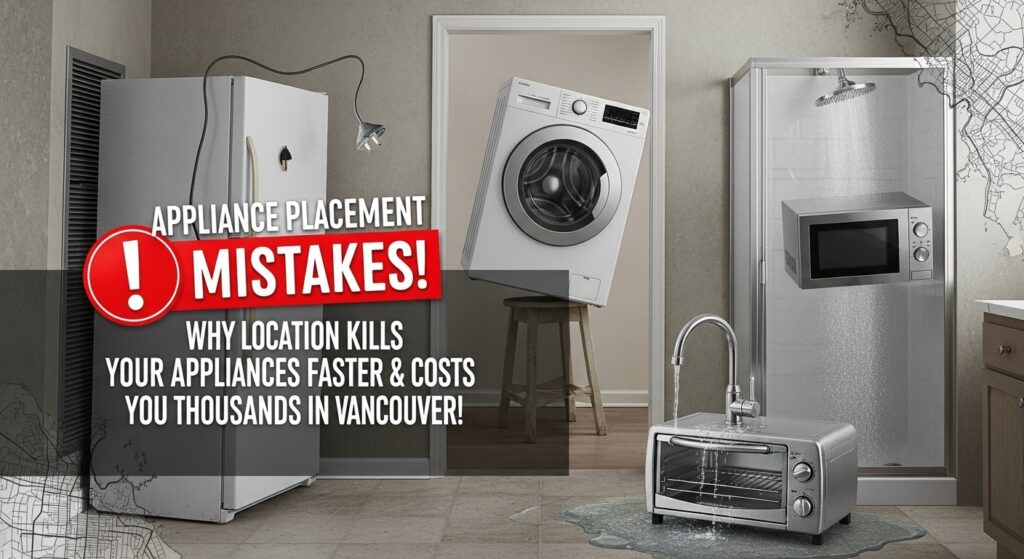
Vancouver Appliance Placement Mistakes: Why Location Kills Your Appliances Faster and Costs You Thousands in Preventable Repairs

Vancouver Appliance Placement Mistakes: Why Location Kills Your Appliances Faster and Costs You Thousands in Preventable Repairs Wondering why your brand-new appliances are breaking down faster than expected despite following all the maintenance recommendations? Vancouver’s unique coastal environment creates hidden placement challenges that can slash your appliances’ lifespan in half while voiding warranties you thought were bulletproof. Related Services: Fridge Repair | Dishwasher Repair | Washing Machine Repair | Dryer Repair Picture this: you’ve just invested $15,000 in a gorgeous kitchen renovation complete with stainless steel appliances that promise years of reliable service. Six months later, your dishwasher starts leaving white residue on everything, the refrigerator compressor is working overtime with strange grinding noises, and that beautiful range hood you splurged on isn’t effectively clearing cooking odors. What seemed like isolated bad luck is actually the predictable result of Vancouver’s notorious coastal climate systematically attacking improperly placed appliances in ways that manufacturers rarely warn you about. [IMAGE PLACEHOLDER FOR IMAGE1] The harsh reality is that Vancouver homeowners face a perfect storm of environmental challenges that make proper appliance placement absolutely critical for long-term performance and warranty protection. Our city’s combination of salt-laden ocean air, persistent humidity, and dramatic temperature swings creates conditions where a refrigerator placed too close to a heat source won’t just work harder – it’ll fail catastrophically within years instead of decades. Meanwhile, installation mistakes that might cause minor inefficiencies elsewhere can void warranties entirely under BC’s strict electrical and plumbing codes.Understanding these hidden Vancouver-specific threats isn’t just about avoiding repair bills. It’s about protecting substantial investments in home infrastructure while ensuring your family’s daily routines aren’t disrupted by preventable appliance failures. The financial implications extend far beyond simple repair costs to include energy efficiency losses, premature replacement expenses, and potential property damage from water leaks or electrical failures that often result from poor placement decisions made during installation. Key Outtakes: Vancouver’s coastal environment accelerates appliance component corrosion and electronic failures at rates up to 40% higher than inland cities due to salt air penetration and humidity infiltration Installation mistakes void more warranties than actual product defects, with electrical connection errors accounting for nearly 40% of rejected warranty claims in the Vancouver area Smart appliance repairs often cost upwards of $350 compared to around $175 for traditional appliance repairs due to complex diagnostic requirements and specialized components Proper appliance placement following Vancouver-specific guidelines can extend equipment lifespans by 3-5 years while preventing 80% of common environmental failures Professional installation becomes mandatory for warranty protection, as manufacturers increasingly require certified technicians to honor coverage under BC’s strict building codes Vancouver’s Coastal Climate Creates Unique Appliance Threats Vancouver’s position between the Pacific Ocean and the Coast Mountains creates environmental conditions that distinguish it from virtually every other major Canadian city when it comes to appliance longevity. The persistent salt air doesn’t just affect outdoor equipment – microscopic sodium chloride particles infiltrate homes through normal ventilation systems and gradually accumulate within appliance components where they initiate aggressive corrosion processes. This salt penetration reaches surprisingly far inland, with homes in Richmond, Burnaby, and even parts of Surrey experiencing accelerated appliance wear that catches homeowners completely off guard. The science behind salt-induced appliance damage involves electrochemical reactions that occur when sodium chloride deposits come into contact with moisture and different metal components within your equipment. Unlike simple surface rust that you might wipe away, this corrosion attacks internal wiring, circuit boards, and mechanical connections where repairs become prohibitively expensive. The process accelerates dramatically in Vancouver’s high-humidity environment, where moisture provides the perfect medium for these destructive chemical reactions to occur continuously rather than just during obvious weather events. Temperature fluctuations unique to our coastal climate create additional stress patterns that gradually compromise appliance integrity through repeated expansion and contraction cycles. While other Canadian cities experience predictable seasonal changes, Vancouver’s weather patterns subject kitchen and laundry equipment to constant thermal cycling that causes rubber seals to develop micro-cracks, metal joints to loosen, and plastic components to become brittle over time. These seemingly minor changes accumulate until they result in sudden, catastrophic failures that often occur just outside warranty periods. The city’s microclimates compound these challenges in ways that many homeowners never consider when making placement decisions. Properties near False Creek experience urban heat island effects that stress cooling appliances, while North Shore homes deal with elevation-related pressure changes that affect sealed systems. Meanwhile, Fraser River proximity in Richmond creates unique humidity patterns that can overwhelm standard appliance drainage systems, leading to mold growth and component degradation in locations where manufacturers never anticipated such conditions. Kitchen Appliance Placement Disasters That Void Warranties The kitchen represents the most expensive appliance concentration in any Vancouver home, making proper placement decisions critical for both performance and warranty protection. Understanding the specific clearance requirements and environmental considerations becomes even more important when you realize that installation mistakes void more warranties than actual manufacturing defects, particularly under BC’s strict electrical and building codes that exceed standards in many other provinces. Refrigerator placement errors rank among the most costly mistakes Vancouver homeowners make, often stemming from a fundamental misunderstanding of how these appliances manage heat rejection in our challenging climate. Placing a refrigerator within 24 inches of an oven, dishwasher, or direct sunlight forces the cooling system to work significantly harder to maintain proper temperatures. In Vancouver’s humid environment, this additional workload doesn’t just increase energy consumption – it creates internal pressure conditions that can cause compressor failure within 3-5 years instead of the expected 12-15 year lifespan. The proper clearance requirements specify minimum 15-inch spacing from heat sources, but many contractors treating this as a suggestion rather than a warranty requirement. Range hood installation represents another critical area where Vancouver’s building codes intersect with appliance performance requirements in ways that create warranty vulnerabilities. Indoor range hoods must be mounted 28-36 inches above cooktop surfaces for optimal capture efficiency, while outdoor installations require 36-42 inches due to different airflow patterns. However, the more serious warranty issue involves electrical connections

Vancouver Appliance Placement Mistakes: Why Location Kills Your Appliances Faster and Costs You Thousands in Preventable Repairs Read More »

Vancouver Appliance Room Ventilation Problems: Why Poor Airflow Causes Breakdowns and How to Fix It Before Expensive Repairs Hit

Vancouver Appliance Room Ventilation Problems: Why Poor Airflow Causes Breakdowns and How to Fix It Before Expensive Repairs Hit Tired of your expensive appliances mysteriously breaking down just months after moving into your dream Vancouver home? You’re not alone – Vancouver’s unique coastal climate and building characteristics create a perfect storm for ventilation-related appliance failures that can slash equipment lifespan by up to 30% while leaving homeowners scrambling for costly emergency repairs. Related Services: Fridge Repair | Dishwasher Repair | Washing Machine Repair | Dryer Repair Picture this nightmare scenario: you’ve just settled into your gorgeous new Vancouver condo with those Instagram-worthy harbor views, complete with stainless steel appliances that cost more than some people’s monthly rent. Everything seems perfect until your smart refrigerator starts throwing random error codes, your washing machine begins its own personal earthquake during every spin cycle, and your dishwasher leaves everything looking like it went through a dust storm instead of a cleaning cycle. What you’re experiencing isn’t just bad luck or manufacturer defects – it’s the harsh reality of how Vancouver’s unique environment systematically destroys appliances in ways that most homeowners never see coming. [IMAGE PLACEHOLDER FOR IMAGE1] The thing is, Vancouver’s coastal environment creates this insidious combination of salt air, humidity, and temperature fluctuations that basically turns your beautiful home into an appliance torture chamber. Add in the ventilation nightmares of high-rise living, where most units receive only about 8% of their intended air circulation, and you’ve got conditions that manufacturers never anticipated when they designed their products. Your appliances are literally suffocating while simultaneously being corroded from the inside out, and most people don’t realize what’s happening until their repair bills start piling up.What makes this situation particularly frustrating is how these problems compound each other in ways that are totally different from single-family home living. In a house, if your dryer vent gets clogged, it’s annoying but manageable. In a Vancouver condo, that same clogged vent can affect your neighbor’s air quality, violate strata bylaws, create moisture problems that damage your hardwood floors, and even pose fire hazards that could impact the entire building. It’s like a domino effect where one struggling appliance creates cascading problems throughout your entire living space. Key Outtakes: Vancouver’s coastal humidity and salt air reduce appliance lifespan by 20-30% compared to interior locations, with electronic components suffering the most damage High-rise buildings deliver only 8% of intended air circulation to individual units, creating moisture retention that forces appliances to work overtime Poor ventilation causes appliance overheating, with clogged dryer vents responsible for 33% of dryer fires nationwide Preventive ventilation maintenance can extend appliance life by 3-5 years while reducing repair costs by up to 85% Professional maintenance strategies tailored to Vancouver’s conditions can save thousands in premature replacement costs Vancouver’s Climate Creates the Perfect Appliance Ventilation Storm Living in Vancouver means dealing with some pretty unique environmental challenges that most appliance manufacturers never considered when designing their products for mass market distribution. Our beautiful coastal location comes with a hidden cost that directly impacts every electronic device and appliance in your home, creating conditions that can literally destroy expensive equipment faster than you’d ever imagine possible. The combination of persistent humidity, salt-laden air, and constant temperature fluctuations creates a perfect storm where standard ventilation approaches simply aren’t adequate for protecting your investment.The salt air that makes our sunsets so spectacular is simultaneously infiltrating your home through ventilation systems, tiny gaps around windows, and even through the building’s concrete structure itself. This isn’t just surface-level exposure we’re talking about – salt particles are actually penetrating deep into your appliances’ internal mechanisms, where they create corrosion on circuit boards, corrode metal components, and interfere with electronic sensors in ways that create mysterious operational problems months or years after the initial exposure occurs. What’s particularly insidious is how this salt accumulation affects appliance ventilation systems specifically, coating exhaust fans, clogging air filters, and creating corrosive deposits that gradually reduce airflow efficiency.What’s particularly challenging about Vancouver’s humidity levels is how they interact with modern appliance technology and ventilation requirements. Today’s smart appliances contain sophisticated electronic components that are exponentially more sensitive to moisture than the simple mechanical systems in older appliances, but they also generate more heat that requires adequate ventilation to dissipate safely. Your Wi-Fi enabled refrigerator, connected washing machine, and programmable dishwasher all contain circuit boards and sensors that were designed for controlled indoor environments, not the persistent 60-80% humidity levels that are normal for Vancouver homes, especially during our long, damp winters when ventilation systems struggle most. The temperature fluctuation cycles characteristic of Vancouver’s marine climate create another layer of destructive stress that most people never consider when thinking about appliance ventilation. Unlike extreme cold climates where appliances adapt to sustained low temperatures, Vancouver’s constant mild fluctuations cause repeated expansion and contraction of metal components, rubber seals, and plastic parts throughout ventilation systems. This thermal cycling is actually more damaging than extreme cold because the materials never get a chance to stabilize – they’re constantly moving, which creates micro-cracks in ductwork, loosens connections in exhaust systems, and gradually degrades seals that are critical for maintaining proper airflow and preventing moisture infiltration.The economic impact becomes staggering when you consider that the average Vancouver home contains approximately $15,000-20,000 worth of appliances, many of which contain electronic components that can fail catastrophically from ventilation-related problems. Research from local appliance repair specialists indicates that refrigeration systems suffer the most severe damage, with compressor failures occurring 30-40% more frequently in coastal locations compared to interior areas. The salt air and poor ventilation create conditions where condenser coils become coated with corrosive deposits that force cooling systems to work overtime, ultimately burning out expensive components that can cost more to replace than the appliance is worth. High-Rise and Condo Ventilation Challenges Accelerate Appliance Death The transition from understanding Vancouver’s climate impact to examining building-specific ventilation issues reveals how these problems compound each other in high-rise living situations. While single-family homes can rely

Vancouver Appliance Room Ventilation Problems: Why Poor Airflow Causes Breakdowns and How to Fix It Before Expensive Repairs Hit Read More »

Vancouver Appliance Resale Value: How Proper Maintenance and Repairs Can Add Thousands to Your Home’s Market Price

Vancouver Appliance Resale Value: How Proper Maintenance and Repairs Can Add Thousands to Your Home’s Market Price Wondering how much your kitchen appliances are actually worth when it comes time to sell your Vancouver home? The answer might surprise you – well-maintained appliances can literally add tens of thousands to your property value in this red-hot real estate market.Picture this: you’re prepping your Vancouver home for sale, and you’re staring at that 12-year-old stainless steel fridge that’s been faithfully humming away in your kitchen. Should you replace it? Repair that wonky ice maker? Or just cross your fingers and hope buyers don’t notice? Here’s the thing – in Vancouver’s ultra-competitive real estate market, where homes average a whopping $1,226,351 and regularly receive multiple offers, every single detail matters. And I mean *every* detail.The reality is that appliances aren’t just functional necessities anymore – they’re legitimate home value drivers that can make or break a sale. We’re talking about strategic investments that, when properly maintained and thoughtfully upgraded, can deliver returns that’ll make your head spin. From energy-efficient refrigerators that save buyers money monthly to smart features that scream “move-in ready,” your appliances are working harder than you think to boost your bottom line.But here’s where it gets really interesting for us Vancouver homeowners. Our unique coastal climate, combined with some seriously generous provincial rebate programs and the city’s REUP energy requirements, creates a perfect storm of opportunity. We’re dealing with salt air that can corrode appliance components faster than you’d expect, but we also have access to BC Hydro rebates and CleanBC programs that can offset upgrade costs big time. It’s like having a secret weapon in the resale value game. Key Outtakes: Modern, well-maintained appliances can increase Vancouver home values by 3-7%, translating to $36,000-$85,000 on average-priced homes Stainless steel kitchen appliance packages deliver a 141% return on investment, adding $5,982 in value for a $4,229 investment Homes with updated appliances sell 15% faster than those without, crucial in Vancouver’s competitive market Regular maintenance prevents up to 30% more appliance failures and extends lifespan significantly Energy-efficient appliances qualify for BC Hydro and FortisBC rebates up to $5,000, offsetting upgrade costs The Vancouver Real Estate Context: Why Appliances Matter More Than Ever Let me paint you a picture of what we’re working with in Vancouver’s real estate landscape. We’re not just dealing with any old housing market – we’re navigating one of the most competitive markets in North America. Vancouver homes receive an average of 2 offers and sell in around 36 days, which means buyers have options and they’re not afraid to be picky.Think about it from a buyer’s perspective for a second. You’re dropping over a million dollars on a property, and you walk into a kitchen with mismatched appliances from three different decades. That avocado green dishwasher from 1985? It’s not giving off “dream home” vibes, trust me. Meanwhile, the house down the street has a complete set of gleaming stainless steel appliances that look like they belong in a cooking show. Which one do you think is getting the full-price offer?The numbers back this up in a big way. 88% of real estate agents say updating kitchens is the best way to appeal to buyers, and when you consider that kitchen appliances are typically included in home sales, they become part of the buyer’s value calculation. This isn’t just about aesthetics – it’s about delivering the move-in ready experience that 48% of millennials are actively seeking.Here’s where Vancouver gets really interesting though. Our market has a Redfin Compete Score that indicates many homes get multiple offers with waived contingencies. That means when buyers are making decisions, they’re often doing it quickly and emotionally. A kitchen that immediately says “this is perfect” versus one that whispers “you’ll need to spend $15,000 updating this” can literally be the difference between getting your asking price and watching offers go to the competition.The coastal location adds another layer of complexity too. We’re dealing with humidity levels and salt air that can accelerate appliance aging, making maintenance and strategic upgrades even more critical. But we’re also in a market where energy efficiency is increasingly important to buyers, especially with BC Hydro rates and environmental consciousness both on the rise. Understanding Appliance Impact on Home Valuation in Vancouver Now that we’ve established the competitive landscape, let’s dive into the actual dollars and cents of appliance impact on home valuation. This is where things get really exciting for Vancouver homeowners, because the numbers are honestly pretty incredible.Consumer Reports indicates kitchen changes including new appliances can increase home value by 3-7%. On Vancouver’s average home price of $1,226,351, we’re talking about $36,790 to $85,844 in added value. That’s not pocket change – that’s a solid down payment on another property or a really nice vacation fund.But here’s where it gets even more interesting. The impact isn’t uniform across all appliances or all price points. Refrigerators are considered essential by 50.9% of homebuyers, with 27.9% willing to pay $1,393 or more for quality units. That tells us that buyers aren’t just looking for any old fridge – they want something that feels premium and modern.When we look at specific brands and features, the data gets really fascinating. Bosch appliances increased home value per square foot by an astounding 132%, while Samsung appliances added 24.1% per square foot value. Meanwhile, GE appliances, despite being most commonly mentioned in listings at 57.4%, actually correlated with reduced home prices by 3.9%. The takeaway? Brand perception matters, and buyers are willing to pay premiums for brands they associate with quality and reliability.The finish and style choices are equally important. Smart appliances added 9.9% per square foot to home values versus 9.2% for standard stainless steel, but energy-efficient features topped the charts at 11.6% per square foot – the highest value among all appliance features. This aligns perfectly with Vancouver’s environmental consciousness and high energy costs.Kitchen appliances consistently outperform laundry appliances in terms of resale value impact, which makes

Vancouver Appliance Resale Value: How Proper Maintenance and Repairs Can Add Thousands to Your Home’s Market Price Read More »

Vancouver Appliance Upgrade Timing: Smart Signs It’s Time to Replace vs Repair Before Your Warranty Expires

Vancouver Appliance Upgrade Timing: Smart Signs It’s Time to Replace vs Repair Before Your Warranty Expires Trying to figure out whether your aging dishwasher deserves another repair or if it’s time to bite the bullet and upgrade? Let’s dive into the smart timing strategies that can save Vancouver homeowners thousands while maximizing appliance performance and warranty value. Related Services: Dishwasher Repair | Washing Machine Repair Picture this: you’re standing in your Kitsilano kitchen on a rainy Sunday morning, coffee in hand, listening to your dishwasher make that weird grinding noise that’s been getting progressively worse over the past month. Your neighbor mentioned their repair guy charged them $400 last week, but you’re wondering if that’s just throwing good money after bad. Meanwhile, your appliance warranty expires in three months, and you’ve been seeing those “Buy Now Before Prices Rise” ads everywhere. As a Vancouver homeowner, you’re dealing with a perfect storm of considerations that make appliance upgrade timing more complex than anywhere else in Canada. Our coastal climate wreaks havoc on appliances faster than the manufacturer manuals suggest, condo living makes replacements logistically challenging, and our premium market means every decision carries serious financial weight. Add in upcoming tariff changes and local rebate programs, and suddenly timing your appliance upgrades becomes a strategic game that can save or cost you thousands. The truth is, most Vancouver homeowners are flying blind when it comes to appliance upgrade timing. They either panic-replace at the first sign of trouble or nurse dying appliances along until they completely fail at the worst possible moment. But there’s a smarter way to approach this, one that considers warranty timing, local market conditions, and Vancouver-specific factors that generic advice completely ignores. Key Outtakes: The 50% rule suggests replacing appliances when repair costs exceed half the price of a new unit, but Vancouver’s logistics costs often tip this calculation toward replacement Upcoming 2025 tariffs could increase appliance prices 5-20% by fall, creating an urgent timing window for purchases before September 2025 BC Hydro rebates up to $12,500 and manufacturer trade-up programs can offset 20-40% of upgrade costs when timed strategically Vancouver’s coastal climate typically reduces appliance lifespans by 10-15% compared to national averages, making proactive replacement more critical Professional pre-warranty expiration assessments can identify upgrade opportunities that maximize trade-up value while avoiding emergency replacement costs Understanding Vancouver’s Unique Appliance Upgrade Market Vancouver’s appliance market operates under pressures that don’t exist anywhere else in Canada, making standard replacement timing advice practically useless. The combination of our coastal environment, premium pricing, and unique housing stock creates a decision matrix that requires local expertise to navigate successfully. The most immediate pressure facing Vancouver homeowners right now is the 2025 tariff impact that’s already reshaping appliance pricing across Metro Vancouver. New tariffs mean appliance prices could jump 5-20% by fall 2025, with the optimal purchasing window closing before September when current inventory depletes. This creates a specific deadline that overrides normal replacement timing considerations – if you’re on the fence about upgrading, the financial math strongly favors action before these price increases hit. Our coastal location adds another layer of complexity that generic appliance guides completely miss. The salt air and humidity levels that make Vancouver so beautiful also accelerate appliance deterioration in ways that shorten expected lifespans significantly. Your refrigerator coils collect salt residue faster, washing machine seals develop mold issues more quickly, and electronic controls suffer from moisture exposure that wouldn’t affect appliances in Calgary or Toronto. This means the standard “wait until it breaks” strategy often backfires, leaving you with emergency replacements during the worst possible timing. Vancouver’s condo-dominated housing market creates logistical challenges that can add hundreds to replacement costs while making repairs more attractive. Moving appliances through narrow hallways, small elevators, and parking restrictions can cost $200-400 beyond the appliance price, and that’s assuming you can even get delivery scheduled quickly. When repair becomes more convenient and cost-effective than replacement purely due to logistics, the standard cost-benefit analysis gets turned upside down. The seasonal demand patterns in our climate also influence optimal timing in ways that national advice ignores. Purchase timing becomes critical before heating season when demand spikes for heat pumps and related appliances, creating supply shortages and higher prices. Understanding these local market rhythms helps Vancouver homeowners avoid premium pricing and limited selection during peak demand periods. The Financial Mathematics of Smart Appliance Decisions Making smart appliance upgrade decisions requires understanding the financial framework that separates good timing from expensive mistakes. The foundation of this analysis starts with the widely-accepted 50% rule, but Vancouver homeowners need to adjust this calculation for local conditions that can dramatically alter the math. The 50% rule suggests that if repair costs exceed half the price of a comparable new appliance, replacement usually makes more financial sense. However, this guideline assumes straightforward replacement logistics and doesn’t account for Vancouver’s unique cost structure. When you factor in delivery fees, installation complications, disposal costs, and potential condo-related surcharges, the true replacement cost often exceeds the sticker price by $300-600. Age-based replacement guidelines provide another critical decision factor, though these too require local adjustment. If your appliance is more than 10 years old, you are usually better off replacing than repairing, but Vancouver’s coastal environment typically accelerates this timeline. Appliances that would normally last 12-15 years in other climates often show significant deterioration by year 8-10 here. The repair cost baseline helps contextualize these decisions with real numbers. The nationwide average cost for appliance repairs is $171, though costs can range from $100 to $350 depending on complexity. In Vancouver’s market, these costs tend toward the higher end due to premium service rates and our challenging service environment. Understanding expected appliance lifespans provides the framework for proactive decision-making rather than reactive replacement. Refrigerators typically last 10-15 years, washing machines and dryers serve 10-13 years, dishwashers function 9-12 years, and ovens/stoves operate 13-15 years under normal conditions. However, Vancouver’s humidity and salt air can reduce these expectations by 10-15%, making proactive replacement around

Vancouver Appliance Upgrade Timing: Smart Signs It’s Time to Replace vs Repair Before Your Warranty Expires Read More »

Call 604-265-3852 Call 604-265-3852 Book Online Book Online