
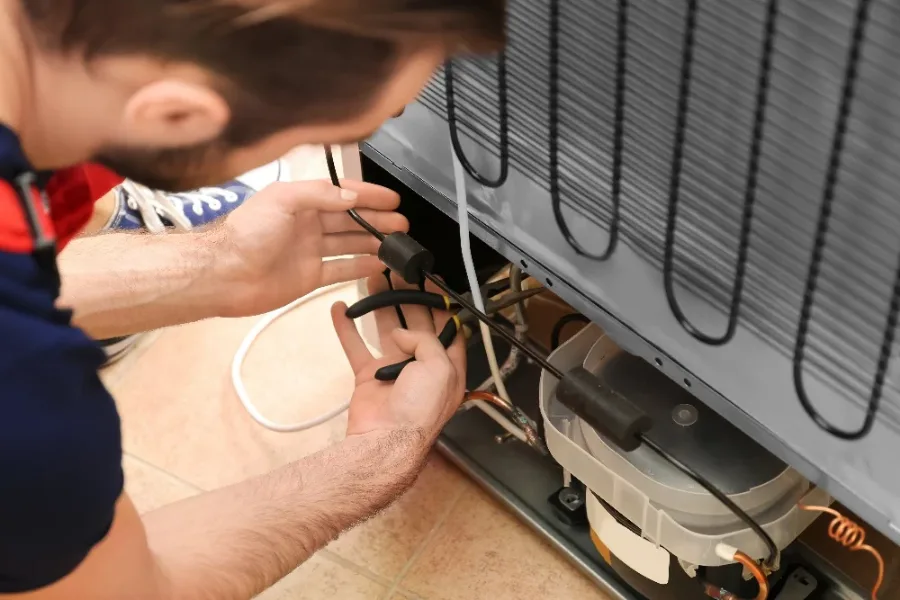
A refrigerator that has gone completely dark and silent may have a blown thermal fuse, but a fridge that runs while the freezer ices over almost certainly does not. Those are two different faults, and they need two different checks.
Related Services: Fridge Repair
This guide explains which symptom points where, how to find and test the fuse, and why a blown one is usually a symptom of something else.
Which fault do you actually have?
Completely dead - no light, no fan, no compressor. Check the outlet with a lamp, then the breaker. If power is good, a thermal fuse or the main control board is a genuine possibility.
Running but not cooling, with frost building on the back wall of the freezer. This is a defrost fault. The defrost system has its own thermal fuse, and when that opens the heater can no longer clear frost from the evaporator coil. Ice builds until air can no longer pass through it, and the fresh-food side warms while the freezer stays cold.
The second is far more common than the first, and it is the one people misread as a dying compressor.
How the defrost thermal fuse works
An automatic-defrost fridge runs a heater near the evaporator coil every few hours to melt accumulated frost. A defrost thermostat controls it, and a thermal fuse sits in the circuit as a backstop. If the heater runs too long or too hot, the fuse opens and kills it permanently.
That is the design working. The fuse is one-time, non-resettable, and it opens because something else went wrong - usually a stuck defrost thermostat or a failed defrost timer or board. Replacing the fuse alone and leaving the cause in place gets you a few weeks before it opens again.
Finding and testing it
Step 1: Unplug the fridge
Not just the light switch inside. Unplug it at the wall, or turn off the breaker if the plug is behind the unit.
Step 2: Get to the evaporator
The defrost components sit behind the rear interior panel of the freezer compartment. Empty the freezer, remove the shelves, and take out the screws around that panel. Expect ice - if the coil is packed solid, that alone confirms a defrost fault.
Step 3: Test for continuity
Set a multimeter to continuity. The thermal fuse is a small sealed component wired into the defrost heater circuit, often taped to the coil or clipped near the top of it. Near zero resistance means intact. Open circuit means blown.
While you are there, test the defrost heater and the defrost thermostat the same way. The thermostat must be cold to test closed, so test it before the coil thaws.
Thawing before you reassemble
If the coil was iced, the ice has to go before the fridge will cool properly again, even with a new fuse. Leave the doors open for several hours, or use a hair dryer on low at a distance. Do not chip at the coil with anything metal - the aluminium tubing punctures easily, and a punctured evaporator turns a $30 repair into a sealed system job at $800 to $1,500.
Frequently Asked Questions
My fridge light is out but it is still cooling. Is that the fuse?
No. The interior light is on a separate circuit from the cooling system. A dead bulb or a failed door switch is the usual cause.
How much does a thermal fuse replacement cost?
The part is inexpensive, typically $15 to $40. Our diagnostic is $100 and applies to your repair labour, with labour on a typical fridge repair in the $225-$300 band. The reason to have it diagnosed rather than just swapped is that the fuse is rarely the root cause.
Can I bypass the thermal fuse?
No. It is the protection that stops a defrost heater running unchecked inside an insulated cabinet. Bypassing it is a fire risk.
When to call
If the coil is iced and the fuse tests open, book a fridge repair. A technician will test the fuse, thermostat, heater and board together and replace whatever actually caused it, so the new fuse survives.