
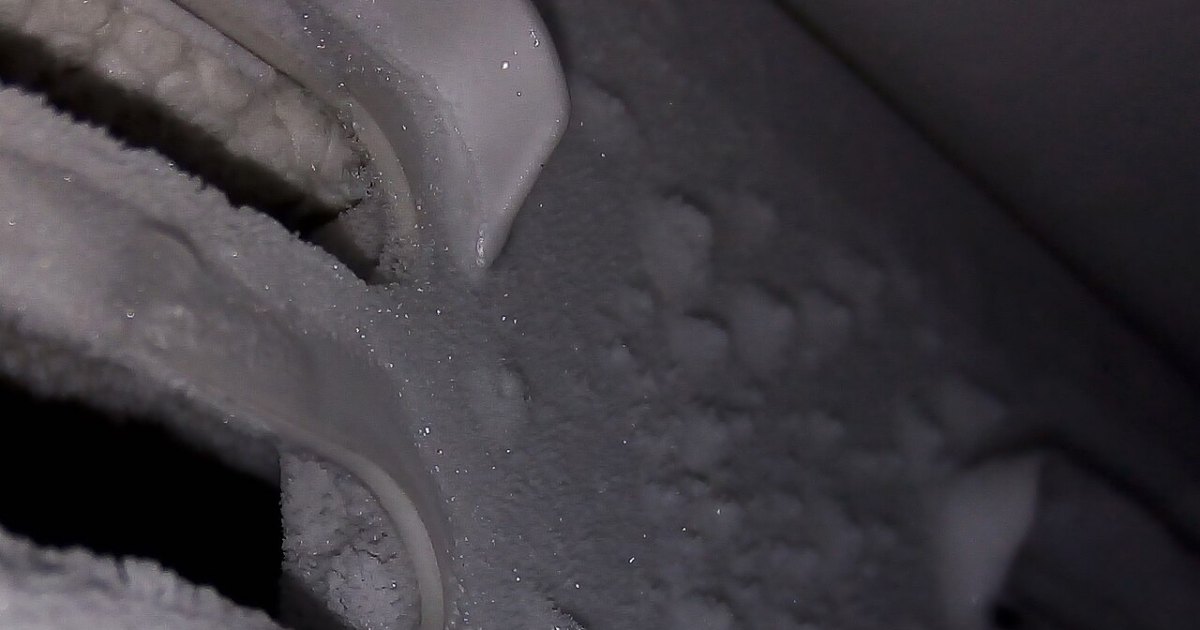
Frost building up in your fridge means moist room air enters the cabinet, or the defrost system has stopped melting the frost it is built to clear. The first fix is the door. Samsung notes that "In many cases, frost occurs due to storing too much food to the point that stops the door from closing." Clear anything in the way so it shuts on its own, then look at where the frost has formed.
Key Takeaways
- Droplets or thin frost on a cold-wall fridge's back wall are normal.
- On a frost-free model, GE recommends service for heavy frost or ice on the rear wall.
- Keep the fridge at 4 °C (40 °F) or lower and the freezer around -18 °C (0 °F). Frigidaire lists a freezer set below 0 °F as a frost cause.
- Never use a hair dryer, knife or ice pick to clear frost.
- Thick frost that keeps building on a frost-free freezer's back panel more than two weeks after a full thaw, with the door and gasket checked, points to the defrost system.
Is ice build-up in your fridge bad?
A little is harmless. A lot wastes energy, and once it covers the vents it stops cold air reaching your food. ENERGY STAR's freezer advice is "Don't allow frost to build up more than one-quarter of an inch." Food safety only comes into it if the fridge temperature climbs above Health Canada's 4 °C (40 °F) limit.
In our experience, a smooth back wall with no vents means a cold-wall (direct-cool) fridge. Beko calls rear-wall droplets or ice on these models "a completely normal part of your Beko fridge's design". That layer forms while the compressor runs, then melts and runs to a channel and an evaporation tray when it stops.
Most full-size models are frost-free, and GE's automatic cycle is "programmed to start every 8-15 hours, depending on the model." LG gives every 4 to 16 hours. Whirlpool's normal is "a light dusting near vents in an automatic-defrost unit that clears after a defrost cycle." Heavier frost that doesn't clear after a cycle or two is worth tracking down.
Humidity matters. Whirlpool says "During months of high humidity (especially if a home is not air-conditioned), it is normal to see some frost". In Metro Vancouver we also see more frost calls through the wet months, when moisture-laden air enters with every door opening.
Where the frost is tells you the cause
Match what you see to this table.
| Where the frost is | Likely cause | What to do |
|---|---|---|
| Droplets or thin frost on a smooth back wall | Normal cold-wall cycle | Nothing |
| Around the door edge | Door not closing, or gasket not sealing | Steps 1 and 2 |
| On food packages and inside containers | Warm or uncovered food | Step 5 |
| Light frost around the vents, with food packed against them | Vents blocked by food | Step 4; a technician only if it thickens instead of clearing |
| Ice on the freezer floor | Blocked or frozen drain | Step 6 (often a technician on frost-free models) |
| Thick frost covering the freezer's back panel and vents, nothing blocking them | Defrost system not keeping up | Step 7, then a technician |
How to stop frost building up in your fridge
Unplug the appliance before any cleaning (steps 2, 6 and 7), as GE advises.
- Make sure the doors close fully. Whirlpool warns "Frost is likely to build if the door is left open for a long period." On dispenser models, Frigidaire adds "The ice chute flap not closing properly can also be a source." See our ice maker guide.
- Test and clean the gasket. Shut a sheet of paper in the door, half in and half out. The Department of Energy says "If you can easily pull it out, you should adjust your latch or replace the seal." For Samsung's test, put a flashlight inside and close it with the room lights off: "Where you can see light shining out from inside, that is where the door is not completely closing." Samsung says to clean the gasket with "warm soapy water and dry it with a soft cloth." A torn gasket needs replacing; see our guide to a loose fridge door seal.
- Check the temperature. Health Canada says "Make sure your refrigerator is set at 4 °C (40 °F) or lower and your freezer at -18 °C (0 °F) or lower." Don't turn it colder to fight frost. Frigidaire lists a freezer "setting below the recommended 0 degrees Fahrenheit" as a cause.
- Clear the vents. Samsung's rule: "Keep two inches of spaces in front of the vents at the back of the compartment."
- Cool and cover food. GE: "Putting warm food in the Freezer, especially if uncovered, will cause a temporary build-up of frost or ice crystals."
- Flush the drain. GE's recipe is "1 tablespoon of baking soda and 2 cups of hot tap water", pushed into the drain hole with a turkey baster. Use hot tap water, never boiling. In our experience the hole on a cold-wall fridge is usually at the foot of the back wall. On many frost-free models it is behind the freezer's rear panel, which we'd leave to a technician.
- Thaw it out by hand. Light frost needs no thaw. Samsung says "Light frost can be wiped away with a damp cloth, and then wiped dry with a second cloth." For heavy frost, LG's method is to unplug it and empty it, including the ice bin. Leave the doors open for at least 8 hours with towels around the base, then plug it back in and allow 24 to 48 hours. Samsung warns "Do not use a hair dryer to speed defrosting." LG says the same of "sharp objects like knives or ice picks."
Frost on the freezer coil can also starve the fresh food side of cold air. See our guide to a fridge that isn't cooling while the freezer is fine.
When frost means you need a technician
On a frost-free model, GE is clear: "If there is ice on the rear wall, or if cleaning the drain tube does not help, we recommend service." For "heavy frost build-up or ice accumulation", it says "a technician will need to check the Refrigerator."
Our test: thaw it out fully, as in step 7. LG notes some frost can form after a power restart and clear by itself within 1 to 2 weeks, so judge after that. If the fridge side is still above 4 °C (40 °F) once the 24 to 48 hours in step 7 have passed, don't wait; call for service. If thick frost is still building on the freezer's back panel past two weeks, and the door and gasket pass, we'd suspect the defrost system: the heater, its sensor or thermostat, or the control that runs the cycle. Another thaw only buys time. Samsung owners with a warm fridge can start with our Samsung fridge not cooling guide.
Frost questions we get asked
Why is my fridge wet inside?
Droplets on a cold-wall back wall come from the normal cycle and run off. Puddles on shelves are different. Samsung explains that "Moisture forms in the fridge when warm air enters through a door being left open". A blocked drain also sends meltwater the wrong way.
Do refrigerators have drains?
Yes. GE says meltwater drains to a pan under the condenser. Heat from the condenser then evaporates it. When that line clogs or freezes, the water refreezes inside. GE's clue: "If ice is on the Freezer floor, the drain tube may be clogged."
Why is my freezer over freezing?
Check the temperature setting first. Frigidaire lists a freezer set below 0 °F (-18 °C) as a frost cause, and damp air getting past the door or gasket does the same. If frost keeps piling onto the back panel after you fix both, suspect the defrost system.
What are the signs of a dying refrigerator?
Frost building up in your fridge is not usually a sign it is dying. In our experience heavy back-panel frost traces to the defrost parts, which can be repaired without touching the sealed system. The signs we worry about are both compartments warming together, or a compressor running nonstop while the cabinet stays warm. Those can point to the compressor or sealed system, though a dirty condenser or failed fan looks the same at first; see our guide to a faulty refrigerator compressor.
Keep the seal clean, and an annual appliance maintenance visit can catch a failing part early. We handle fridge repair across Metro Vancouver. Call 604-265-3852 and we'll tell you whether it's the seal or a job that needs parts.
More about our technicians, or contact us about your fridge. We cover Metro Vancouver and the Fraser Valley.
Photo: Frost in Freezer by Doggo19292, public domain. Cropped.