Oven temperature fluctuations are more common than most people realize — and they’re responsible for a lot of burned edges, undercooked middles, and baking disasters that get blamed on the recipe. If your oven doesn’t hold temperature, there’s usually a clear reason for it.
Here’s how to test whether your oven temperature is accurate, how to run a basic calibration, and when the sensor or thermostat needs replacing.
Related Services: Oven Repair in Vancouver
How to test if your oven temperature is accurate
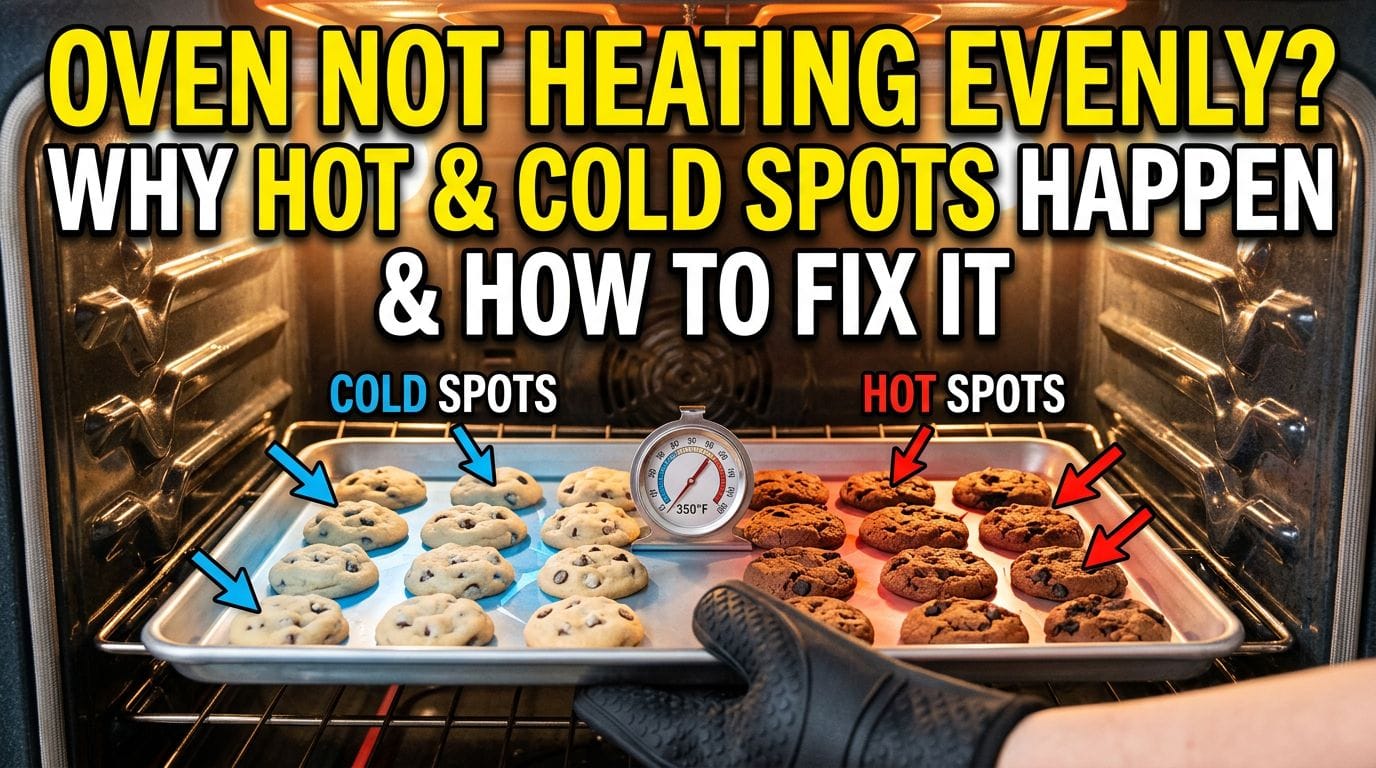
The fastest way to check: buy an oven thermometer (they cost $10 to $20 at any kitchen store). Place it in the centre of the oven on the middle rack. Preheat to 350°F (177°C), wait 20 minutes after the preheat indicator beeps, and read the thermometer.
Most ovens cycle within a range — the element shuts off and on to maintain temperature. You might see 330°F to 370°F during that cycle, which is normal. If the thermometer reads below 300°F or above 400°F consistently, the oven has an accuracy problem.
Run the test at two more temperatures — 400°F and 450°F — to see if the error is consistent or gets worse at higher settings.
DIY oven calibration
Many ovens have a built-in calibration offset you can adjust through the control panel. This lets you shift the oven’s temperature up or down by up to 35°F (about 20°C) without replacing any parts.
How to access calibration on most models:
- Samsung: Hold BAKE for 8 seconds. The display shows the current offset. Use the temperature arrows to adjust. Confirm with BAKE again.
- LG: Press Settings, then navigate to the oven calibration option. Some LG models require holding the 0 button for 5 seconds.
- Whirlpool / Maytag: Press BAKE, then hold for 5 seconds. Use + and – to adjust offset in 5°F increments up to 35°F total.
- GE: Press BAKE and BROIL simultaneously and hold for 3 seconds. Adjust with the number pad.
- Bosch: Access through the Settings menu on the display panel. Look for “Oven Calibration” or “Temperature Offset.”
If your oven runs 25°F cold, add 25°F to the offset. If it runs hot, subtract. Check with the thermometer after adjusting.
Oven temperature sensor replacement
The oven temperature sensor (also called the RTD sensor or thermistor) is a probe inside the oven cavity, typically mounted at the top rear. It tells the control board what temperature the oven is at. When it drifts or fails, the board gets wrong information and the oven can’t maintain temperature properly.
Signs the sensor is failing:
- Oven temperature varies widely (50°F or more off target)
- Error codes like F3 or F4 (sensor fault codes on most brands)
- Oven overheats or underheats despite correct settings
- Calibration adjustment doesn’t help
Testing the sensor with a multimeter: At room temperature (around 70°F / 21°C), most oven sensors measure about 1080 ohms. If yours reads significantly different (or open/infinite), the sensor is bad. Replacement sensors for most brands cost $20 to $60 and are usually two screws and a plug-in connector — a genuine DIY job once you’ve identified the right part number.
When it’s the oven thermostat, not the sensor
Older ovens (pre-2000, many without digital displays) used a mechanical thermostat rather than an electronic sensor. If you have an older range with a physical dial, the thermostat itself may have drifted or failed.
Mechanical thermostats aren’t adjustable — when they drift, replacement is the only fix. A replacement thermostat costs $40 to $120 depending on the brand, and installation is more involved than a sensor swap.
Other causes of oven temperature fluctuations
- Failing bake element: If the lower element has a crack or hot spot, it won’t cycle correctly. Look for visible damage — blistering, dark spots, or a break in the element.
- Loose sensor connection: The sensor wire can corrode or come loose from the connector. Check the connection at the back of the oven if you’re replacing the sensor anyway.
- Control board fault: Rare, but the relay that controls the element can fail. This is usually diagnosed after the sensor and element are confirmed good.
- Door seal worn: A damaged door gasket lets heat escape, which causes the oven to cycle more aggressively to compensate. The temperature can feel erratic because it is — the oven keeps overcooking to make up for the loss.
Oven running too hot — what to check first
An oven that consistently runs 25°F or more hot is usually a calibration issue or a sensor fault. Run the thermometer test first. If calibration doesn’t bring it into range, test the sensor resistance. If the sensor checks out, the issue is likely the control board relay.
When to call a technician
DIY makes sense for: sensor replacement (straightforward on most models), calibration adjustment, and checking door seals. Call a technician if: you see error codes you can’t clear, the oven overheats significantly (more than 50°F above target), the element shows visible damage, or the problem started suddenly rather than gradually drifting.
Vancouver Appliance Service repairs oven temperature problems across Metro Vancouver. We stock sensors and elements for most major brands and can typically diagnose and fix the issue in a single visit.