
Panasonic Microwave Repair
Countertop, over-the-range and built-in Panasonic microwaves, including inverter models.
Microwave Repair In Vancouver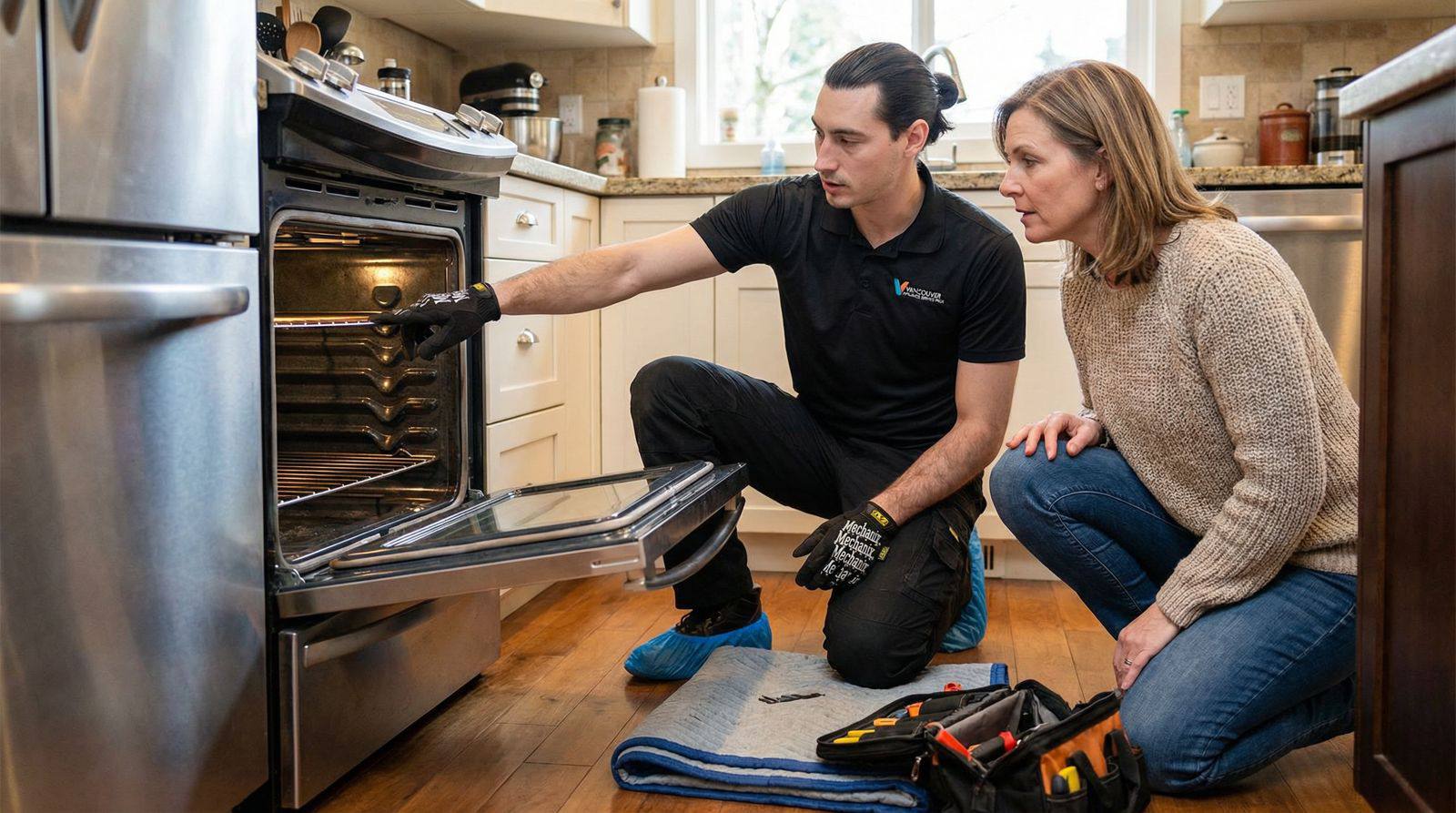
Our Red Seal certified techs (ITA# K42107427) handle Panasonic appliance repair in Vancouver and across Metro Vancouver. Inverter microwaves - countertop, over-the-range and built-in. Call 604-265-3852 or book online. We are open seven days a week and can usually book you in the same week.
Vancouver's leading Panasonic appliance repair experts Red Seal technicians, OEM Panasonic parts, and a 6-month repair warranty.
Panasonic microwaves are everywhere in Vancouver, and almost entirely on the strength of one piece of engineering: the inverter.
A conventional microwave has one power level. To give you 50 per cent it runs at full power half the time and switches off the other half, which is why conventionally defrosted food cooks at the edges while the centre stays frozen. A Panasonic inverter delivers genuinely reduced continuous power instead. That is why they defrost and reheat more evenly, and it is why people replace a broken Panasonic with another Panasonic.
It also changes what breaks. A conventional microwave has a transformer, a capacitor and a diode feeding the magnetron. An inverter model replaces that assembly with an electronic inverter board, so the classic high-voltage failure points are simply not present and the inverter board is the part that goes instead. Diagnosing one as though it were a conventional microwave wastes everyone's time.
The range covers countertop units, over-the-range models and built-in installations using a trim kit, and the repair economics differ sharply across those three.
Countertop, over-the-range and built-in Panasonic microwaves, including inverter models.
Microwave Repair In VancouverOn an inverter Panasonic this points at the inverter board or the magnetron, and the two present almost identically from outside. There is no transformer or high-voltage capacitor to test, which is what a technician used to conventional microwaves goes looking for first.
We test the inverter's output rather than guessing between them. On a built-in or over-the-range unit the repair is usually worth doing. On a countertop model the part alone often approaches the price of a new machine, and we will tell you that before you spend anything.
No display means no low-voltage supply, which is a different fault from no heat. Check the outlet with something else first - over-the-range units are frequently on a circuit shared with a GFCI that tripped elsewhere in the kitchen.
If supply is confirmed, it is the line fuse, the control board or a door interlock switch. The interlocks are the interesting case: they are wired so that a failure can take the whole unit down rather than merely disabling the start button, which is a safety design working correctly.
Microwave doors carry several interlock switches that must agree the door is closed before the magnetron energises. They are mechanical, they are operated every single time the door moves, and they wear. A door that needs pressing or lifting to make the unit start is telling you the switches or the latch have gone out of adjustment.
This is worth fixing promptly rather than working around. Switches are inexpensive, and a failing interlock on a machine that produces microwave energy is not a fault to live with.
The least serious fault on the list. Either the drive coupler under the glass tray has cracked and is slipping, or the turntable motor beneath the cavity floor has failed. Both are inexpensive parts and neither affects safety.
Lift the tray and the roller ring and check the coupler first - a split coupler is visible and is the cheaper of the two. Food does heat unevenly without rotation, so it is worth putting right.
Stop using it and unplug it. Sparking is usually one of three things: metal in the cavity, food residue carbonised on the cavity wall, or a damaged waveguide cover - the small mica panel on the side wall that keeps splatter out of the waveguide.
A burnt or perforated mica cover is a cheap part and a straightforward replacement, and it is the most common cause we find. Running a microwave that arcs will eventually damage the magnetron, which turns a minor part into a major one.
On an over-the-range Panasonic the ventilation is a second appliance sharing a cabinet with the microwave. Most are recirculating rather than ducted outside, venting back into the room through a charcoal filter, and that filter is a consumable almost nobody replaces.
A saturated charcoal filter means the fan runs and the kitchen still fills with smoke. It is a cheap part. If the filter is fresh and it still will not clear, we look at the blower and the damper. More on microwave repair.
Panasonic distributes into Canada and parts for current models - interlock switches, turntable motors, couplers, mica waveguide covers, charcoal and grease filters - are inexpensive and usually available within days. Inverter boards and magnetrons are ordered against your model and serial, typically within a week.
The economics are the honest part of this brand. On a built-in or over-the-range Panasonic, where replacement means a unit plus installation and possibly a trim kit, repair is usually the clear answer. On a countertop model an inverter board or magnetron frequently costs more than a new machine, and we will tell you rather than quote it. Cheap parts like an interlock or a mica cover are worth doing on any unit.
Panasonic's warranty typically runs longer on the magnetron than on the rest of the appliance, which catches people out - a no-heat fault on a unit a few years old is sometimes still covered. The rating plate is on the back or inside the door frame; read us the model and serial and we will check before you pay.
We order genuine Panasonic parts, read the factory service bulletins and train on current models. Our Red Seal techs (ITA# K42107427) are licensed with Technical Safety BC (BC30591) and have been repairing appliances across Metro Vancouver since 2012.
1,100+ Google reviews at 4.8 stars. If you need Panasonic appliance repair in Vancouver, we are the appliance repair company to call.


There is no high-voltage transformer, capacitor or diode - an inverter board replaces that whole assembly. So the standard microwave diagnostic does not apply, and the inverter board is the part that fails instead.
Depends on the type. On a built-in or over-the-range unit, usually yes. On a countertop model the board or magnetron often costs more than a replacement machine, and we will say so.
No. Unplug it. It is most often a burnt mica waveguide cover, which is a cheap part, but continuing to run it will damage the magnetron and turn a small repair into an uneconomic one.
Check the charcoal filter. Most over-the-range installs recirculate rather than duct outside, and the charcoal filter is a consumable that is almost never replaced. Saturated filter, no extraction.
$100 diagnostic, credited to your repair labour. Typical labour is $225-$300. Built-in and over-the-range units sit at the upper end because they have to come down out of the cabinetry, and that is quoted before we start.
Our Red Seal technicians repair every major brand sold in Metro Vancouver.






































or book an appointment online today